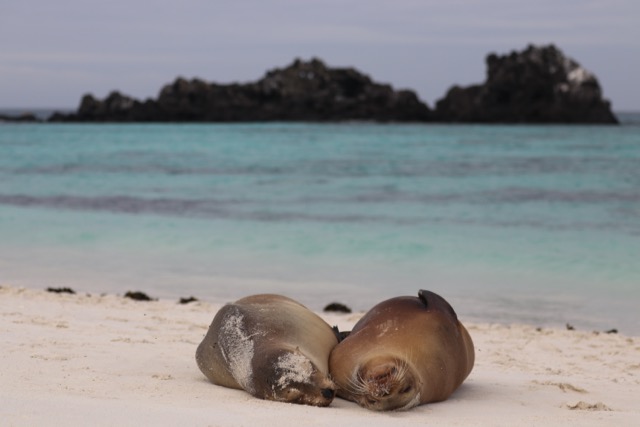
Nature seems at its most bountiful here though there are strains beneath the beauty. Arriving to board our cruise boat, sea lions were swimming beneath the landing, frigate birds and blue footed boobies were flying overhead and iguanas were basking on rocks and lying across the roadway to the fuel depot. The animals were unafraid of people and had to be worked around. The islands are part of a large protected reserve, the first area of World Heritage declared by UNESCO (United Nations Environmental Scientific Cultural Organisation).
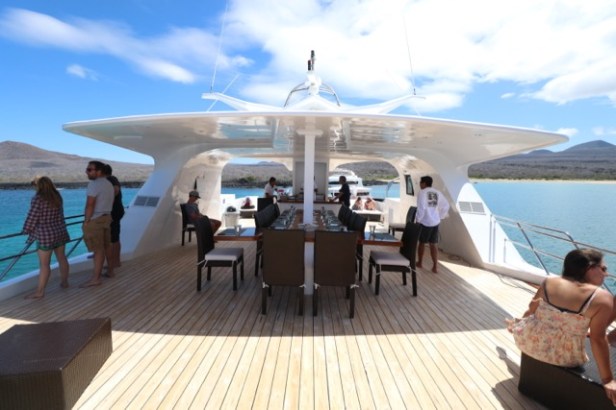
We’d not been on a cruise before and were fortunate to be on a boat that had been in service for only 4 months: the ‘Natural Paradise’. It was a beautiful craft and had 16 passengers and 11 crew plus a nature guide. Visiting the bridge on our last evening (they ran an open bridge), the Ecuadorian captain and crew proudly explained the features of the boat and we were shown the high-tech equipment for navigation and security. There was a screen that brought together footage from several cameras that showed what was going on in some crew zones such as the engine room, the galley (which was surprisingly big), the crew’s mess and the public spaces for passengers (so we got a comprehensive tour just by going to the bridge.) They explained the various satellite emergency response systems and it was all very high-tech. I hadn’t given it much thought but was very impressed at the safety features of the craft and the extent and sophistication of its workings. When we were standing on the bridge, two dolphins leapt up in front of the boat, about 4m in the air. It was incredible. A group of four kept just swimming and leaping ahead of the boat for quite awhile.
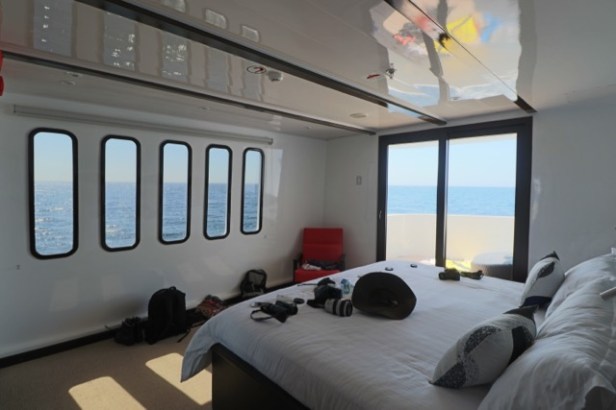
We’d splurged on a cabin with a balcony and it was wonderful. We had long, low side windows looking out at the water too – what a treat.
Our days involved a routine of fine food interspersed with morning and afternoon activities. What was not to like?
Snorkelling featured most days, sometimes twice a day. The water was surprisingly cold, given we were practically on the equator courtesy of the Humboldt current coming up from the Antarctic. This current brings a lot of nutrients to the waters of the islands being part of the reason for their bountiful wildlife. Our guide dipped a jar in the water showing us the krill creature carried in the current. It was like a transparent shrimp a few centimetres long (like a sea monkey?). We were issued with wetsuits and the women were offered an option of full length ones for added warmth. Mine was excellent with only my hands and feet freezing at a couple of the snorkeling sites. In the shorter suits, some people got really cold and had to give up early. Hot chocolate would be served after the snorkeling at cold sites. The goggles were excellent too, sealing onto your face really well providing you didn’t have any stray strands of hair. The visibility when the glass was freshly cleaned was great, but you had to remember not to breath through your nose at all, otherwise the mask was never going to clean up as well as before.
Some days the water was a bit murky, but others crystal clear. We saw lots of beautiful fish and animals in the water with highlights being turtles and sea lions. We went snorkeling adjacent to rocky cliffs or sometimes from beaches. The long wetsuits were extra buoyant so I found it very tricky swimming where you intended, when there were currents and waves. On our first day I just seemed to attract turtles and had a great deal of difficulty steering to avoid collisions. It’s hard to judge the distances in the water too. You’re supposed to stay 2m away from any animal. It was crazy stuff trying to back pedal madly in the water on occasion.
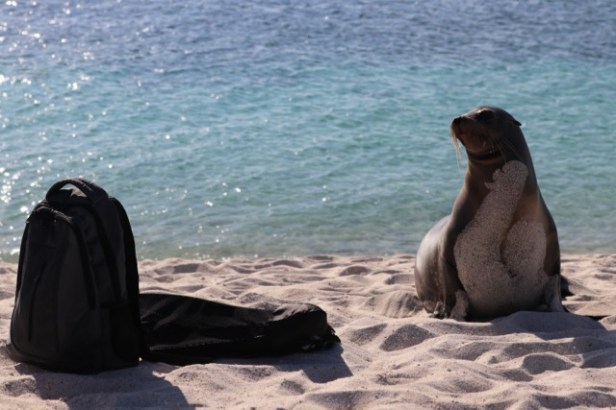
Sea lions are delightful creatures, apart from the head males. They liked to sleep a lot in comfy spots digesting their food. Park benches and small fishing boats were popular perches though our guide told us his family’s lounge room got taken over one day when he left the door open (you have to keep the doors closed). The sea lions loved the couch. His mother was not happy!
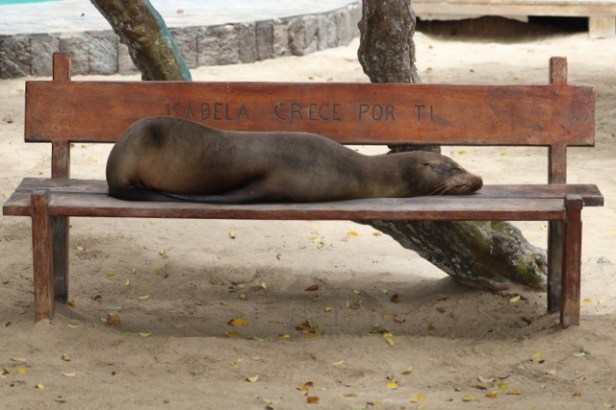
They lived in colonies of around 50 females looking after their young protected by one male. The male heads of the colonies were cranky and aggressive towards other male sea lions and sometimes visitors. They only lasted as ‘alpha’ males for about 3 weeks before being deposed. They worked so hard, barking at the colony to get them out of the water late in the day, issuing cautionary sounds to keep other sea lions and intruders at bay and chasing other males away. We saw a few males chase away others sea lions at a totally unexpected speeds. One defended a long beach we visited for snorkeling patrolling an extensive stretch of water. When snorkelers went into the water at the far end of the beach, along came the head male barking aggressively and swimming around the pangas (local name for a zodiac – to rhyme with kangas) to make sure they didn’t go in the water. No wonder they only lasted a short time as the head male. It was serious labour.
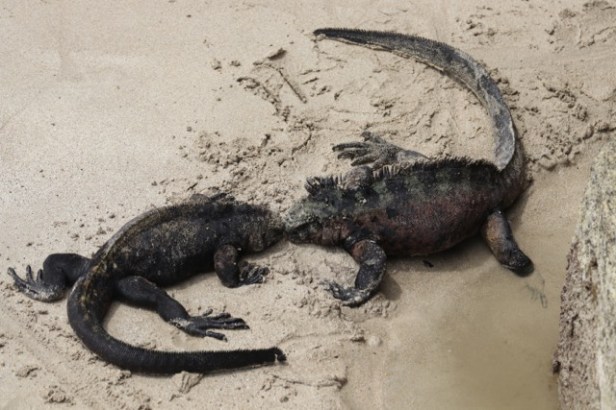
The monochrome marine iguanas could be cranky too with the males getting into disputes and head butting each other. They wiggled their heads up and down to communicate and then it often turned ugly. We saw one get progressively headbutted backwards many metres across sand.
They lived in big colonies and slept in piles at the end of the day (presumably to keep warm), and were amazing swimmers. 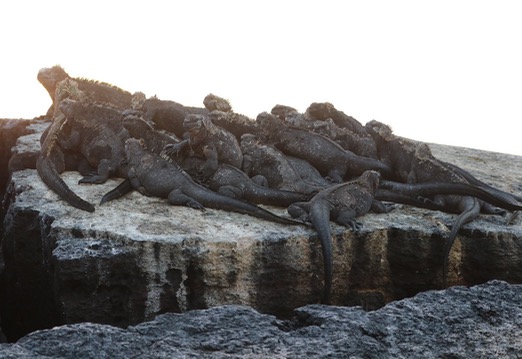
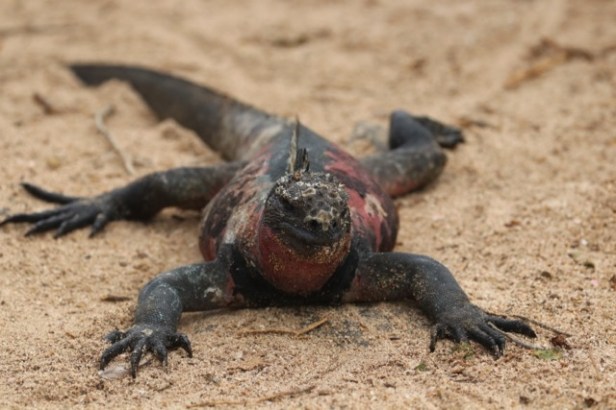
There were the land iguanas too which were brightly coloured, bigger and with a different species (and colour scheme) on each island. They were more solitary so we didn’t see many compared to their teeming marine cousins.
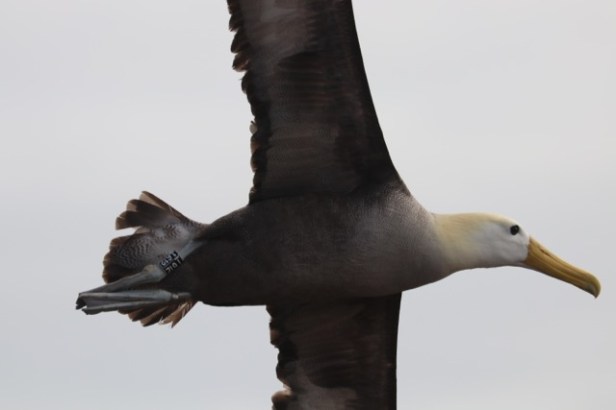
The penguins were gorgeous. We didn’t see then in big numbers anywhere but in small numbers at several sites. They bobbed around in the sea happily and perched on the rocks with the marine iguanas, sea lions and other sea birds. Wave albatrosses were so impressive close up with their enormous wingspan which you only really appreciated when they were moving around clumsily on the ground. 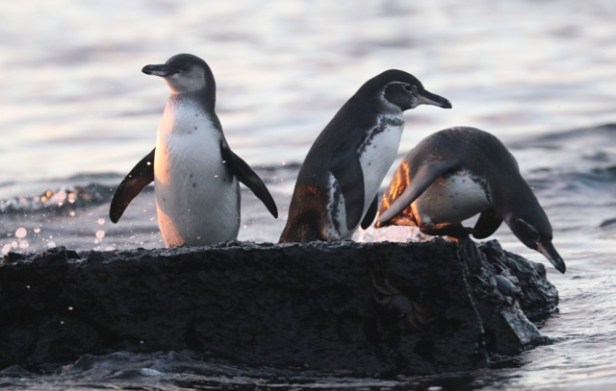
The albatross colony we saw existed for most of the year, until the population migrated to the South American mainland waters when the currents seasonally change to make the albatrosses’ food supply dry up. The young looked so helpless and different to the adults.
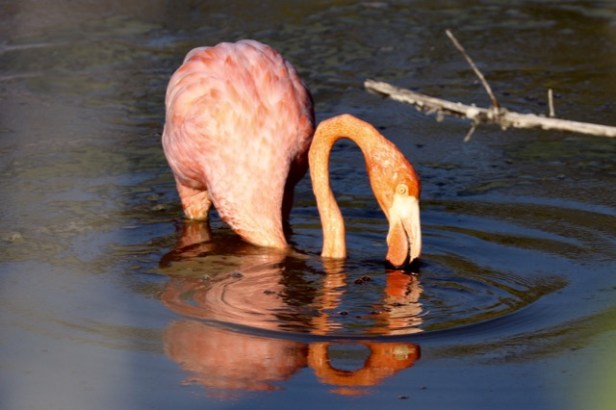
Spectacular flamingoes in small numbers are found on a number of islands.
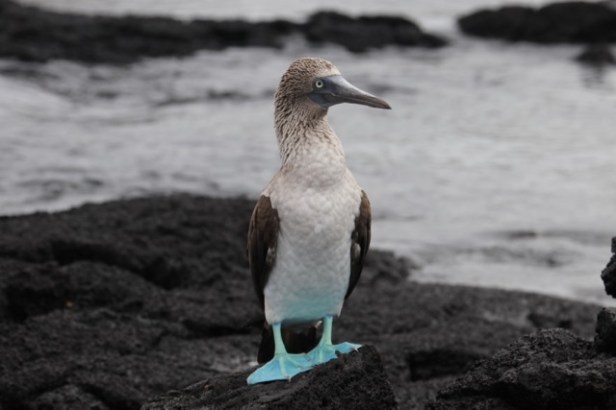
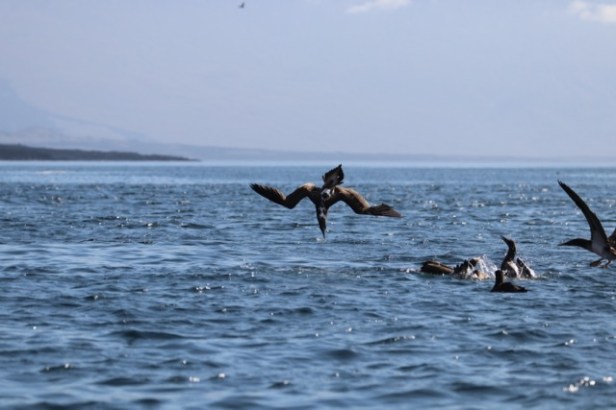
Blue footed boobies are common also on most islands though we only saw them doing their spectacular dives en masse into the ocean for fishing at one place. Apparently their skulls are especially reinforced to cope with the repeated impacts from diving.
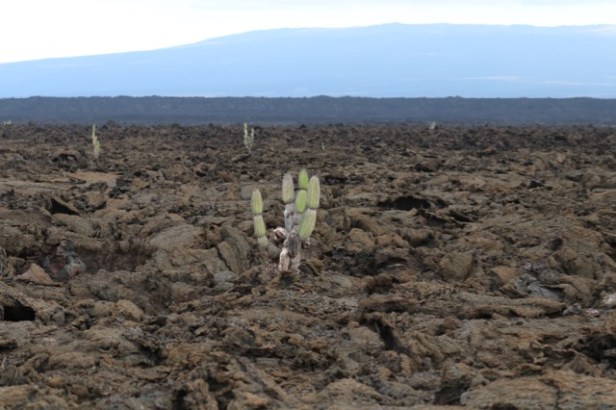
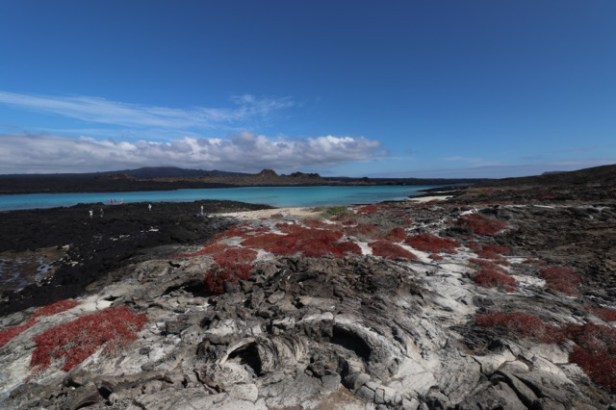
The islands are generally dry with spartan vegetation apart from greenery dominating the higher volcanic hills of the major islands. Extensive lava beds on the newer islands are inhospitable with only candelabra cactus breaking up the landscape in places. Brackish lakes appear where lava tubes have collapsed too. Upon landing at Baltra Airport, it was strange to be confronted with prickly pears (‘Galapagos’ prickly pears) as the main visible vegetation. Yet, these landscapes all provide the perfect environment for particular species.
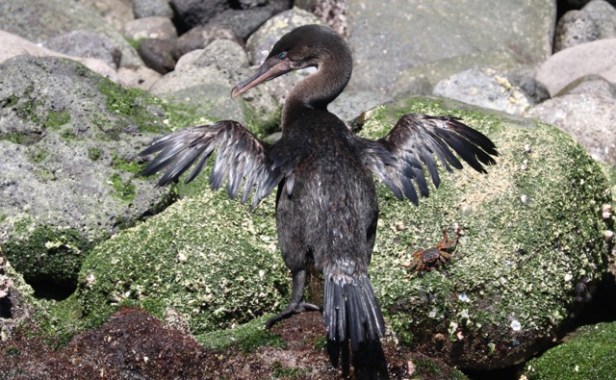
 They have major problems on the Galapagos with feral animals sadly. It is such a delicate ecosystem and one where the animals of the islands were very gentle versions of animals elsewhere because of the ready availability of food. Their only snake, for example, is non venomous. Their cormorants are flightless. Their black widow spiders aren’t poisonous. Animals didn’t have to have significant defences against predators so the ecosystems have suffered badly in the face of intruders.
They have had introductions from early sailors of rats, goats, cats and dogs and the later farm animals such as donkeys and cows caused lots of problems too. Ticks and flies were introduced at some point. The latter caused the snoozing sea lions much discomfort and they covered themselves in sand at times to discourage their attentions.
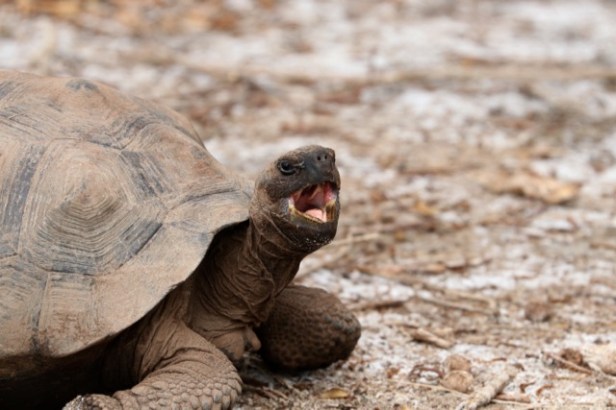
The tortoise is no longer able to naturally reproduce on any of the islands as the young do not survive. They cannot survive the predation of hawks, dogs and cats, the trampling of donkeys and cows and assaults from aggressive rats, ants and ticks. Their reproduction is now supported at breeding centres on several islands where the tortoises can grow to a size where they can be safely released (at the age of 20 years or so).
The National Parks Service is very active in trying to manage the various issues impacting on the Galapagos Islands ecosystems but with regard to feral animals it’s mostly about controlling numbers rather than being able to eliminate them. They have had some successes on small islands, but on the larger inhabited islands they face greater challenges.
There is heavy regulation of where tourists are allowed to visit and how they spend their time on the islands and in the waters. No boat is allowed to visit a site more than once every 14 days to try to even out the pressure on popular locations. Times are allocated for boats and access to the national parks is only permitted during daylight hours.
But there are many residents and visitors and they all put pressure on the delicate environment.
Despite all these issues, the Ecuadorian government is doing a fantastic job as the Islands custodian. It is a truly magical place.
 Marian's Travel Blog
I watched Russell Crow in a movie last night and saw a good snapshot to The Galapagos–your blog in reality. What a trip!
The ship looks like something I would enjoy.
LikeLike
You would have indeed Peter.
LikeLike
Your wildlife photos are amazing.The iguanas would be scary
For me,as they are like baby crocs!Ship looks fantastic,and
with just enough passengers and crew to be really efficient.
I’d never realised that they had so many introduced pests
what a huge job for the authorities.
Marvellously descriptive blog Marian.
LikeLiked by 1 person
Wonderful descriptions and photography. Attenborough’ s next assistant?
LikeLike
What a fantastic experience .Wonderful wildlife.
LikeLike
Looked like such an amazing place.
LikeLike