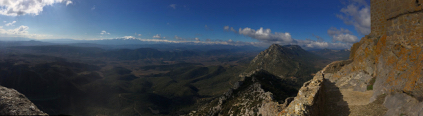
The Cathars left a remarkable legacy from their endeavours in 13 th century Languedoc, south-west France. The remains visible today include spectacular fortresses and the castle settlement of Carcassonne.
Queribus Castle was an outstanding example situated on an exposed peak in the Corbieres Hills. This landmark had been the last to fall into the hands of the northern French Crusaders in 1255.


It was a bleak and confronting place surrounded by precipitous cliffs. On our visit, the wind was extraordinary making it difficult to move, let alone climb the rough steps up to the defensive keep. The force of the buffeting winds all around let up at moments so you surged forward. The warning signs couldn’t prepare you for the blasts and bitter cold – hold onto the kiddies. There were slits for arrows and other close combat weapons and outer defensive walls where different projectiles could be employed. There were also opportunities to pour things onto storming invaders at the main gates. It had a desperate air.
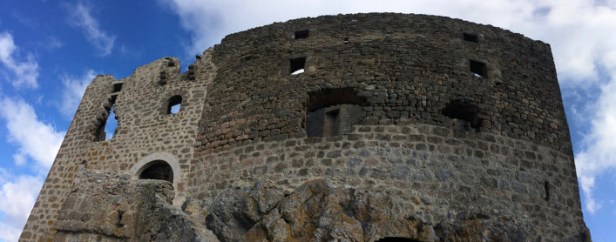 The castle overlooked valleys to the north and south with the snow covered Pyrenees looming behind. It was one of a series of Cathar castles surviving today on a small range to the north of the Pyrenees.
The Cathars had been subject to systematic genocide and were basically eliminated within two generations by the actions of the Catholic Church and the French monarchy. This group had been widely supported in the Languedoc region by both nobles and the broader community. Their beliefs brought conflict with the Catholic church of the day concerning heaven, evil and a whole raft of aspects. They believed that senior church people should not be rich nor differ in their lifestyle from their followers and the most fundamental concern of all – that tithes should not be paid to the Catholic church.
Their conflict with the Catholic church led to the Albigensian Crusade (named because many of their adherents came from the Albi area, just north of Carcassone). 500,000 people were killed as a result of the violence directed to the Cathars. Whole villages had their populations slaughtered. They were eradicated.
Even today the Queribus site tourist brochure reflected bias against the Cathars to me. There was no reference to the last stand there and the death of half a million people. Instead, it talked primarily about the Cathars beliefs!
The conflict against the Cathars also brought a change in alignment of the Toulouse area from connection with Barcelona (and Aragon – Spain) to that of the French monarchy. In south-west France the borders changed many times from the natural barrier of the Pyrenees to alignments to the north as political pressures have played out. A treaty of 1258 redrew the boundary between France and Aragon to the south of the Corbieres hills within sight of Queribus. It was a key frontier castle for 400 years, besieged numerous times until a Treaty of the Pyrenees in 1659 fixed today’s frontier and it lost its strategic importance.
The cross border sympathies apply to this day with Catalan spoken in south east France and visible in some signage, similar architecture, the display of Catalonia independence flags in some towns and cultural aspects such as similar regional food specialities.


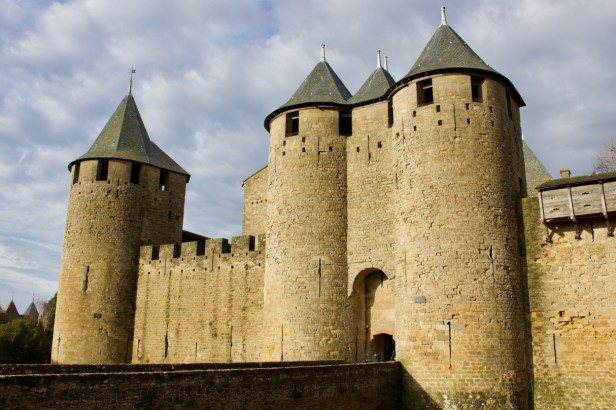
Carcassone was another stronghold for the Cathars. They were the first group to create a great defensive castle on the site though occupation dated back to much earlier times. Roman mosaic floors were recovered under one section of the castle. It was the scene of most action from 13th, 14th and 15th centuries attacked, besieged, changing hands many times over its life. After this time, it deteriorated greatly until a farsighted architect drove the restoration of the dilapidated castle during the 1820’s-1850’s. As original drawings had been destroyed by fire, the structure was restored to show its condition and appearance in the 13th century.


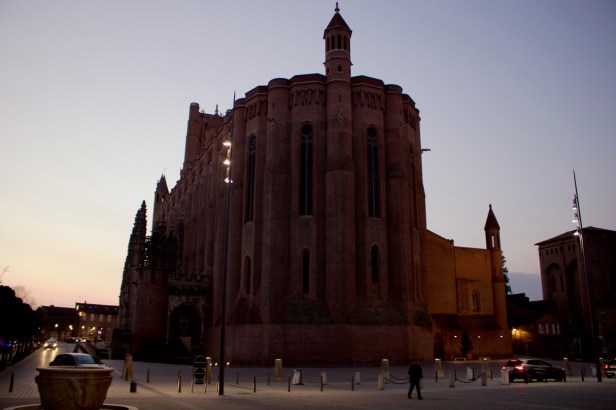
After the brutality of the Albigensian Crusade, the Catholic church constructed Albi’s enormous statement red brick cathedral in 1282. The fortress like cathedral was constructed to reflect the power and authority of the Catholic church. It was the largest brick building in the world at the time and remains so today. The cathedral and the adjacent Bishop’s Palace, which houses the excellent Toulouse Lautrec museum were constructed with their defences protecting them from the adjacent town, rather than the invading forces. Later additions have sought to diminish its brutalist appearance. There is a local connection with Brisbane too, with the architect for St Brigids church at Red Hill, Robin Dodds intentionally drawing on significant architectural design elements from Albi cathedral.


Heading south, Barcelona is a hive of activity. We stayed in the Gotic quarter, full of stone buildings and the winding laneways of the old town. It’s a terrific place to spend time and wander around looking at the interesting shops, fine buildings and the historic highlights of the quarter, which dates back to Roman times. There is such a creative flair on display in this city too with its Gaudi buildings and embrace of artistic activity and specialist food culture. Sadly there are hordes of tourists though. After see few tourists further north in France, it was a shock to encounter the volume of visitors Barcelona hosts in a quiet time of the year – it must be hideous during the busy times.
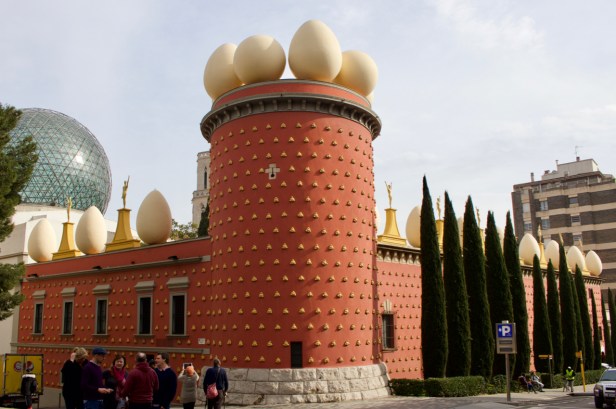
Heading north from Barcelona, Dali’s museum in Figeura was a treat. He created a beautiful showcase for his creative endeavours in this gallery in the former town hall of his hometown. He lived in a restored tower building next door, covered in egg shapes and bread loaves – a man of the people.


Girona was another pleasure with several somewhat familiar settings. It was the site of some key scenes from ‘Game of Thrones’. For example, Cersie was forced to walk shamed and naked down spectacular stairs from the palace – actually the cathedral of Girona. The city was a spectacle full of corners and scenes that looked familiar from that series. The ramparts which we walked around had been restored and marked the boundary of the old town, including its Jewish quarter which thrived before the Inquisition. There was also a small bridge designed by Gustave Eiffel, early in his career.


After that, a return to the chilly north.
 Marian's Travel Blog