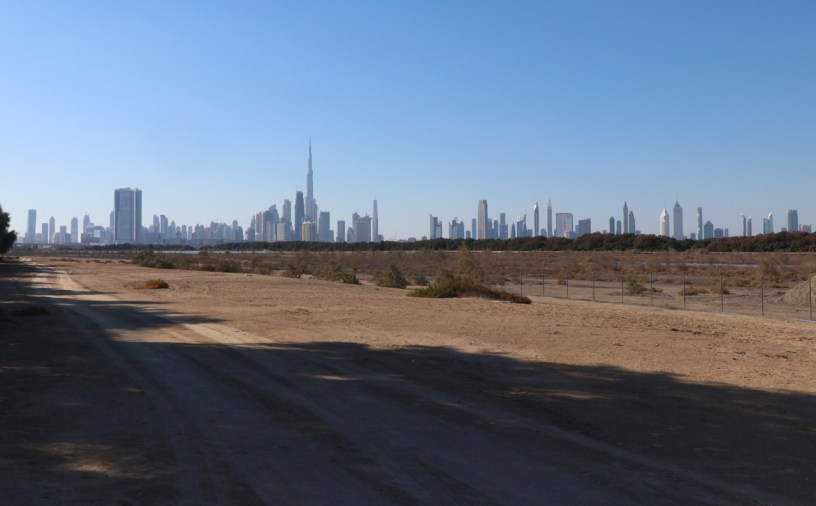
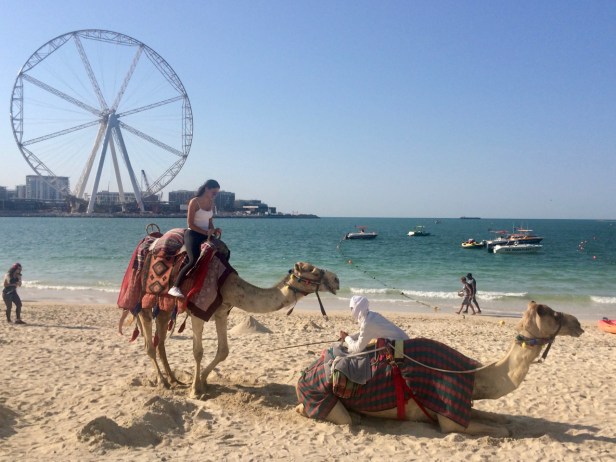
Nothing about Dubai is small. It is a place of superlatives. Three 12 lane road corridors, 6 lanes in each direction, are the life blood of Dubai. These arteries run roughly parallel with the coast of this vast linear city that stretches more than 50km along the Persian Gulf. They fuel its pulsing movement of people, buses, trucks and cars. Vehicles range from dazzlingly expensive to humble all moving to their own rhythm and speed. They are generally driven very fast, erratically and dangerously. On these major roads, lanes don’t relate to the speed of vehicles, with slower vehicles on the outside. Rather, lanes are unimportant with lane changing and overtaking occurring everywhere though the most frighteningly fast manoeuvres generally start or finish from the left-most side of the roads. Trucks escape some of the chaos being largely confined to the inland road. The crazed drivers of these roads are generally moving in excess of 140 km per hour. Our time on the 12 lane roads involved adrenaline, sharp breathing, controlled exhalation and fancy car spotting. But the roads are efficient and Dubai is big.
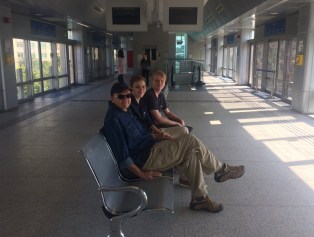
The Metro is another linear feature with its red line stretching from the airport in the north over 50km to the south served by impressive elevated stations.
They showcase stylish functionality with their distinctive metal Opera House style arch design identical throughout the city. They are air-conditioned, feature themed coloured interiors and are accessed via long escalators. From its 2009 opening it was the world’s longest driverless single metro line until surpassed by Vancouver.
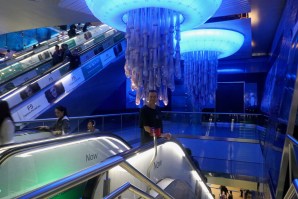
In the older city area, lavish underground stations operate on the second major u-shaped line that links to the red line at two major junctions. The powers that be (an inspired sheik) decided in 2014 these should showcase art and they now feature spectacular works in the midst of commuters and other metro users.
A metro extension is proposed for the Expo in 2022 and no doubt, further extensions will be built with the expansion of urban areas to the east and to serve the new Dubai airport.
A new airport is being built for Dubai! The existing airport is already the world’s busiest for international passenger movements and is enormous and involves extended walks for any passenger through its portals. The distances are vast. The new airport to the north was initially planned to provide six runways able to handle landing planes simultaneously. It was subsequently ‘scaled back’ to provide for only five parallel runways and has opened to local carriers. It will have the capacity to serve as the busiest airport in the world. A fast rail network is proposed to link to the existing airport 25km away.
Nothing is done on a small scale in Dubai.
The Palm Jemeriah is an enormous land reclamation exercise projecting into the Persian Gulf providing an endless supply of waterfront property. The Palm extends around four kilometres into the sea. Its’ outer ‘frond’ extends around towards the trunk providing a 12km or so circular stretch of waterfront land. International hotels are already operating and many more are establishing on the outer frond. Patrons cannot walk anywhere but are moved around in mini-buses.
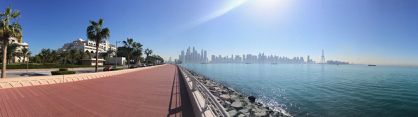
The inner fronds are generally luxury villas and exclusive gated communities. Fortunately the Arabian Gulf is not prone to tsunamis and experiences only very limited tides. Where all the visitors are going to come from to make these hotels viable is questionable.
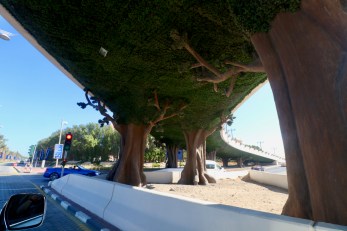
However, China and India with their growing middle classes are not far away and the Arab world itself provides a huge population of potential clients. Dubai is also regarded as the most pleasant city in the Middle East in which to work, so expatriates and business entities must generate enormous business for hotel sector.
Pedestrian opportunities are not a particular feature of visiting the city apart from in controlled settings like the airport and shopping malls, where the pedestrian experiences are exhausting. Mind you, the climate would mitigate against extended strolling outside for much of the year.
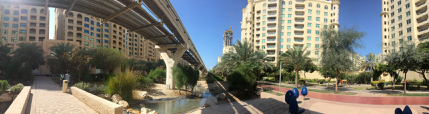
Where we stayed, on the ‘stalk’ of Palm Jemeriah, was an exception to the lack of pedestrian opportunities with a fantastic pedestrian spine along with a new monorail connection along the central apartment precinct of the ‘stalk’. It was a landscaped network with an extended waterway feature and softfall running track extending what seemed to be a couple of kilometres.
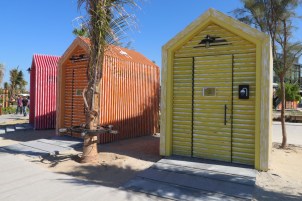
These softfall tracks are also provided in the new beachfront locations we visited that have been developed as integrated shopping and recreation centres at a couple of attractive Dubai beaches. The design outcomes are very good, but they are small scale and recent.
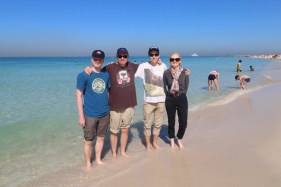
A larger palm project to the south approximately twice the size of the existing palm has been reclaimed, but works have been put on hold to enable demand to catch up with land supply. Of course, this doesn’t worry the developers, as they are companies owned by royalty and they can wait out the market.
Similarly the world’s islands project has had little traction with a few small structures only on the maze of islands visible from Dubai’s attractive beaches.
Shopping is an important economic activity in Dubai. The Dubai Mall is the largest shopping centre in the world. It opens every day until midnight or 1am on Thursdays, Fridays and Saturdays. It throngs with people clad in every type of garb imaginable from hipster youth, shoppers from around the globe in western shopping attire, to the robes and head gear of Arabic men and graceful cloaking garb of women sometimes with their faces entirely shrouded from sight. Every one is there to shop though. Some stores are for the very wealthy with armed guards visible at a few stores. Eating places provide for dining experiences from around world.
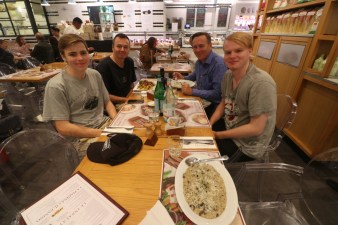
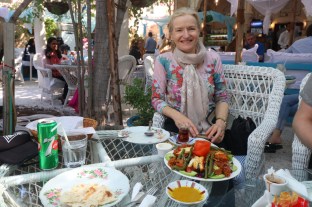
We ate at Eatily based on the format of an Italian marketplace. This enterprise originated in the United States a decade ago with dining, provisions and even cooking classes available on site. The space was cavernous set around groups of tables, with action areas around the side preparing the different menu items, from pasta, to pizza, etc. All of the food ingredients were available for sale in the store along with tasting opportunities. The food was delicious.
We missed the spectacular Burg Khalifa (tallest building in the world) New Year light show sadly. It was scheduled too late for our visit being at 10pm – too late for our jet-legged crew. The light show we saw a few years ago was awesome, but when we saw footage of the current News Years show they had really excelled themselves.
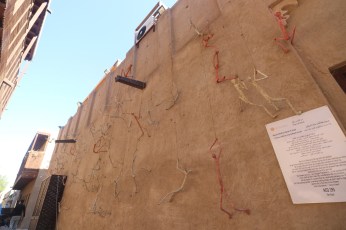
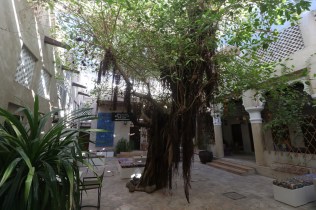
The downtown heritage precinct was impressive with the powers-that-be having made a big effort to ensure its preservation. A small museum with installations outlines the history of the city. There are several traditional restaurants with courtyard gardens and an old quarter of shops, galleries and boutique accommodation.
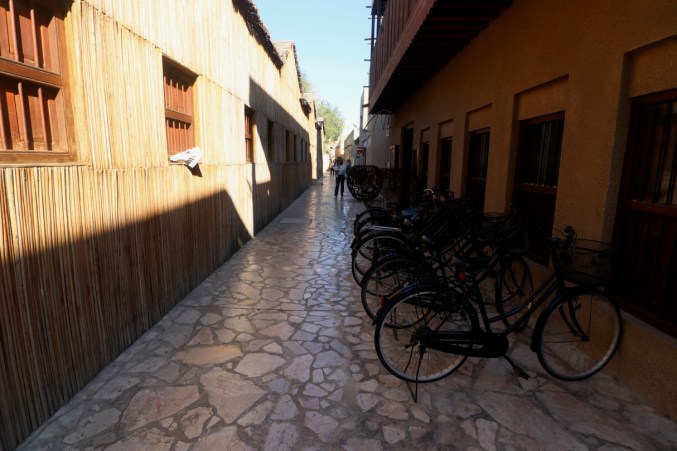
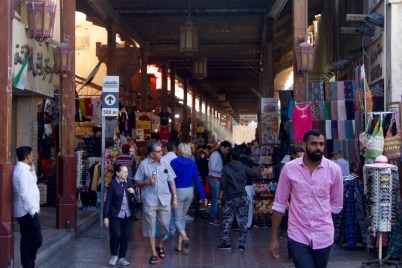
An impressive mosque tower stands adjacent to the entrance to the bazaar of spice stalls, handicrafts, traditional foods and consumer goods (fake?) such as sunglasses and watches. The traditional market wrangling still goes on. Looking at watches for Sam involved a trip out of the market quarter going around a corner and up two floors in a tiny lift to inspect additional watches, which were great but sadly out of his price range.
A visit to the Museum of Islamic Culture at Sha Jahan, a neighbouring Emirate, was impressive being a showcase for Islamic artistic, cultural and scientific accomplishments. It featured extensive ceramics and artwork over many centuries from many different places, historic displays with fascinating astrolobes, replicas of the Jai Singh setup from Rajastan, a display on book binding over the centuries, an explanation of the beliefs of the Islamic faith and a temporary exhibition of paintings from an Englishman Edward Hope who had painted a lot of ink and watercolour works from an early 20th century pilgrimage to Mecca by car.
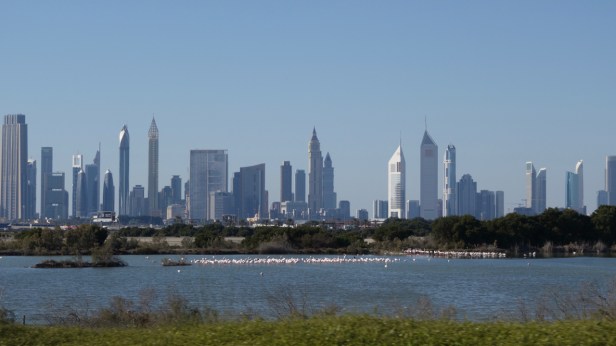
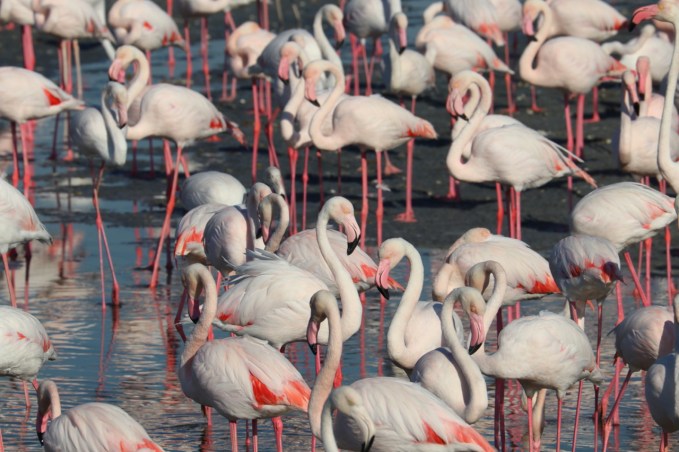
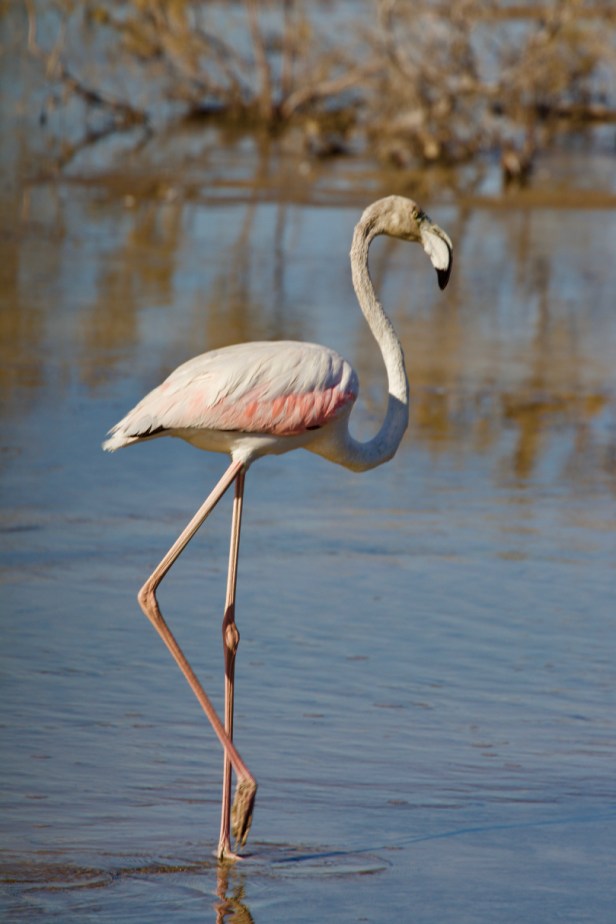
A visit to a nature reserve where flamingoes could be seen against the backdrop of Dubai’s skyline was a particular treat after the man-made excesses of Dubai. The wetlands behind the city are important for numerous migrating bird species.
The flamingoes and other water birds were a stunning sight.
 Marian's Travel Blog
Your blog is fascinating! Thanks so much for sharing:) k
Sent from my iPhone
>
LikeLike